










Managing Noise in Utility-Scale Energy Storage Projects: From System Design to Site Operation
2026-10-20
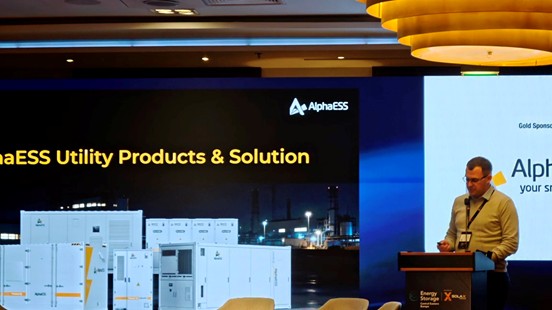
As utility-scale energy storage projects expand across Central and Eastern Europe, noise is becoming an important consideration alongside capacity, efficiency and safety. Site conditions, local regulations and proximity to nearby communities can all influence how a project is designed.At Energy Storage Summit Central and Eastern Europe 2026 in Warsaw, Šarūnas Venslavas from AlphaESS shared the company's experience in noise management for utility-scale battery energy storage systems (BESS), covering key noise sources, mitigation methods and project examples.

Understanding Noise Sources in BESSNoise in a battery energy storage system does not come from a single component. Battery units, power conversion systems (PCS) and transformers all contribute to the cumulative noise level of a project.
AlphaESS presented a combination of active and passive mitigation measures. Active measures include moving from air to liquid cooling, optimizing exhaust position and using noise reduction kits for AlphaESS BESS and PCS units. Passive measures include sound-absorbing enclosures and barriers, strategic site layout, and natural landscaping such as trees and earth mounds for additional sound buffering.
Project-Specific Noise Control
Noise requirements vary by project and site conditions.
In Germany, AlphaESS has applied custom housing and ventilation systems in projects including a 3 MW / 6 MWh installation in a water protection zone in Oberpfalz and a 2.5 MW / 5.015 MWh project in Lingen. The housing acts as a physical barrier to reduce sound transmission, while thermal management relies on the battery’s own heat in winter and passive ventilation in summer.
A more demanding example is a 160 MW / 320 MWh project at a confidential coal-fired power plant site. The BESS was required to generate no more than 50 dB at a distance of one metre from the system, and no more than 25 dB at measurement points near a village. This called for attenuation of 35 dB for the PCS, 25 dB for the battery system and 15 dB for the transformer.
The project solution included custom forced-ventilated noise enclosures for the BESS, PCS and transformer, together with sensor-driven ventilation control. The project shows how noise limits can directly shape equipment configuration, enclosure design and ventilation strategy.

Noise Management Beyond Commissioning
Noise management continues after commissioning. AlphaESS highlighted compliance with local noise regulations, engagement with surrounding communities to understand their concerns and expectations, regular noise monitoring to confirm compliance and identify emerging issues, and routine maintenance to keep noise-reducing features in optimal condition.
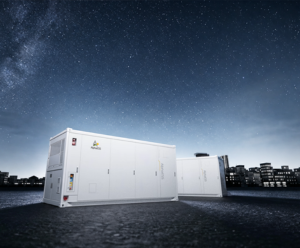
For utility-scale energy storage projects, noise control needs to be considered together with system design, site layout and long-term operation. These approaches are backed by practical experience across multiple utility-scale projects in Europe, where AlphaESS has applied different noise-control measures according to site conditions and project requirements. Noise considerations are also reflected in the design of the Aster 6260, which integrates battery, BMS, cooling and fire protection in an all-in-one containerized system, with intelligent thermal management and a specified noise level of ≤70 dB@1m.
For utility-scale energy storage projects, noise control needs to be considered together with system design, site layout and long-term operation.

-

 Managing Noise in Utility-Scale Energy Storage Projects: From System Design to Site Operation
2026-10-20
-
 How Aster 6260 Creates Long-Term Value for Utility-Scale Energy Storage Projects
2026-08-26
-
 Managing Noise in Utility Scale Energy Storage Projects Key Challenges and Practical Approaches
2026-06-18
-
 AlphaESS Achieves Dual Safety Milestones: IEC 62443 Certification and UL 9540A Fire Test Agreement at SNEC 2026
2026-06-10
Share this: